


What riders say about our cooling rugs
We like to use them after transport, when heat has built up in the trailer. My horse accepts the cooling down very well and seems much more content afterwards.
— Trusted Shops Review
With temperatures over 30 degrees at the tournament, the cooling blanket really made the day easier for us. Between tests, our horse was able to cool down comfortably.
— Customer review for the cooling blanket (Cool Down)
Our horse doesn't like being hosed down at all. It accepts the cooler rug without any issues, however, and stands there completely relaxed.
— Trusted Shops Review


Support during heat and thermal stress
When moving, horses produce large amounts of heat and release a significant portion of it through sweat and its evaporation. At high outside temperatures, this heat dissipation becomes more demanding. A cooling rug is therefore designed to support cooling rather than retaining heat against the body. Especially after training, at competitions, or on very warm days, it can contribute to active heat management.
When is a cooling blanket useful?
Cooling rugs are suitable for situations in which your horse needs extra support in dissipating heat. However, for a significantly overheated horse, rapid active cooling with plenty of cold water should always be the first priority.
- On hot summer days: When there is high heat stress, a cooling rug can help to pleasantly cool the body surface and offer your horse additional relief.
- After training or competition: Once a horse that has become very hot has been actively cooled down first, a cooling rug can support the subsequent cooling phase.
- During training and competition breaks: Targeted cooling can be useful between periods of exertion if your horse has already built up a lot of heat and needs to recover.
- For horses that do not tolerate heat well: Some horses are more sensitive to high temperatures. A cooling rug can be part of a well-thought-out heat management strategy involving shade, water, and sufficient breaks.
- On the road and in the stable: Depending on the design, lightweight cooling rugs can also be used on the road or in the stable when controlled cooling is desired on warm days.
The advantages of high-quality cooling ceilings
A good cooling blanket should not trap heat, but rather actively assist in its dissipation. Crucial factors, therefore, are the cooling effect, air circulation, a lightweight design, and a comfortable fit.
Supports heat dissipation
Cooling materials help to absorb excess heat on the body's surface and release it into the environment.
Cooling over large areas of the body
Unlike localized cooling products, a cooling blanket can cover large areas of the back, torso, and croup simultaneously.
Lightweight for warm temperatures
The construction is designed for summer use and is not intended to provide any unnecessary additional insulation.
Good air circulation
Air-permeable materials support the exchange with the surroundings and thus also evaporation on the ceiling surface.
Uniform contact
A suitable blanket rests against a larger area of the horse and can therefore distribute cooling more evenly.
Flexible in use
Depending on the design, cooling rugs are suitable for use during training, tournaments, in the stable, or in other situations involving high heat stress.
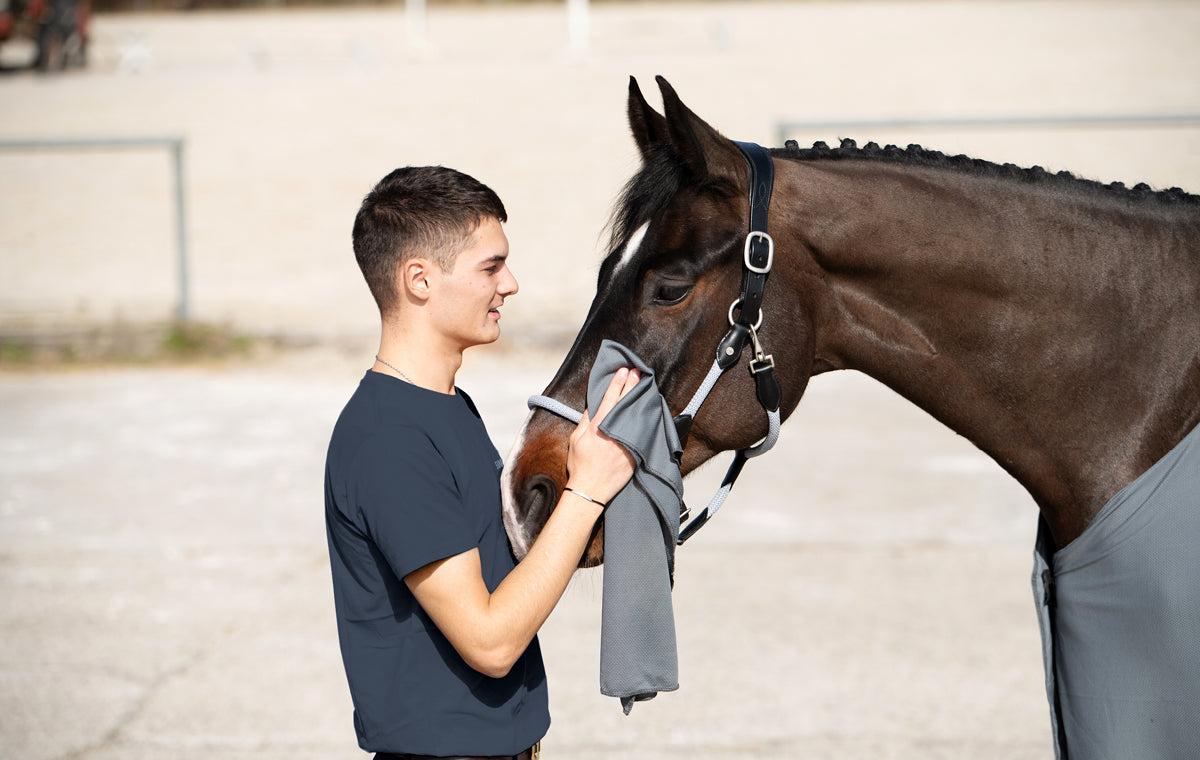
How evaporative cooling works in horses
When water evaporates, this process requires energy. This energy is absorbed as heat from the surroundings, which in the case of a wet cooling rug includes, among other things, the warm surface of the body. This creates a cooling effect as long as water can evaporate from the material. Air movement supports evaporation, while high humidity slows it down.
Frequently Asked Questions (FAQs) about chilled ceilings
How does a cooling blanket for horses work?
That depends on the specific material principle. Many cooling blankets are activated with water and use evaporative cooling: when water evaporates, heat is absorbed, thereby cooling the surface of the body.
When should I use a cooling blanket?
It is particularly suitable on hot days, during recovery phases after training or competition, and wherever your horse needs additional support with heat dissipation.
Why does a wet cooling blanket provide a cooling effect?
Energy is required for water to evaporate. This is absorbed as heat from the surroundings. As a result, the temperature on the body surface can drop as long as moisture is evaporating.
Does a cooling blanket work just as well in high humidity?
No. The more humid the ambient air already is, the more slowly additional water can evaporate. Evaporative cooling blankets therefore work more effectively in dry air and with air movement than in conditions of very high humidity.
How long can a cooling blanket be left on the horse?
That depends on the temperature, material, humidity, and the horse. Regularly check whether the blanket still has a cooling effect and whether your horse feels comfortably tempered. If the material becomes dry or warm, it must be reactivated with water or removed.
Can I put the cooling blanket on immediately after training?
Yes. A water-activated cooling rug is dampened and can be placed directly on the warm horse without you having to hose it down first. The evaporation of the stored water then provides a longer-lasting cooling effect. However, for a severely overheated horse, a cooling rug alone is not sufficient. In that case, rapid cooling with plenty of cold water is the more effective method.