


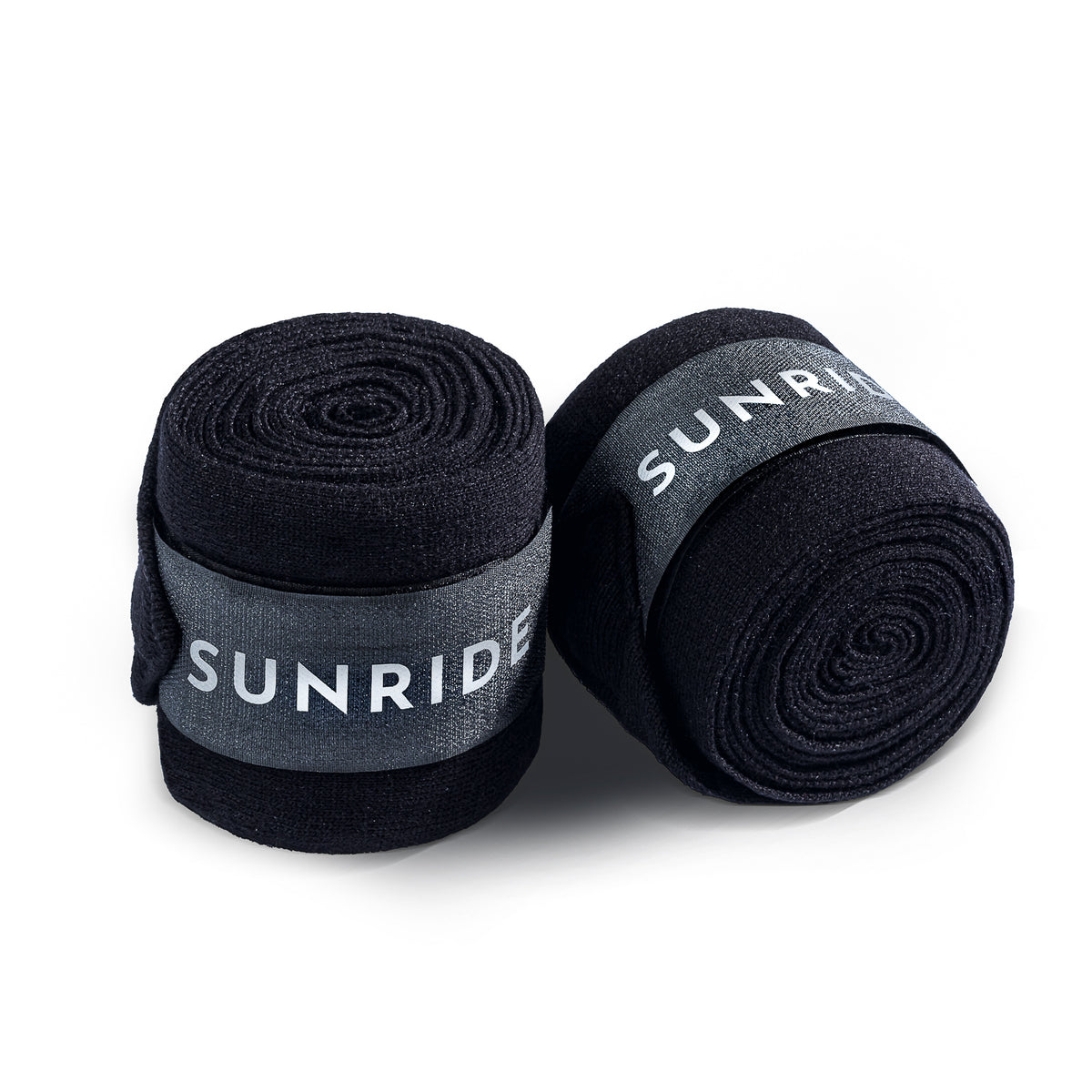


What riders say about our bandages
The fleece bandages are pleasantly soft. Really great for the price.
— Trusted Shops Review
The color matches my saddle pad perfectly, so I decided to take the bandages with me right away. They arrived neatly rolled up and the Velcro fasteners are holding up perfectly so far.
— Customer review of training bandages


Why bandages should be used selectively
Bandages sit against a large area of the horse's leg and can therefore perform several tasks: they protect against external influences, provide uniform external support to the tissue, and, when used with appropriate padding, can distribute pressure over a larger surface area. However, the correct wrapping technique is crucial, as too much or uneven pressure can strain sensitive structures just as much as a bandage that is too loose.
Which support is right for your needs?
Our bandages differ in material and area of application. This allows you to choose the version that suits your training, rest period, or transport needs, without using more material than necessary on the leg.
- For training and daily work: Our classic bandages protect against brushing and self-striking and can be adjusted to fit the horse's leg closely.
- For soft protection during training: Our fleece bandages lie softly against the leg, provide comfortable cushioning, and are particularly suitable when a supple material is desired.
- For longer rest periods in the stable: Our stable bandages are designed for comfortable wear while standing and, when used with suitable padding, can help provide even external pressure on the leg.
- For transport: Correctly applied bandages can protect the legs from contact and friction with one another during short or controlled transport, provided they are securely fitted and checked regularly.
- For horses that are prone to brushing: Due to their large coverage area, our bandages can shield sensitive areas from direct contact with the opposite leg.
The benefits of our supports
Our bandages combine flexible adjustment with protection that fits directly against the horse's leg. It is not just the material that counts, but also how evenly the bandage is applied.
Protection against external injuries
Our bandages protect the skin and underlying structures from self-inflicted strikes, brushing, and light direct contact.
Uniform external pressure
When wrapped correctly, the pressure is distributed over a larger area, which can provide even support to tendons, joints, and surrounding tissue.
Individually adjustable to the leg
The wrap adapts more flexibly to the shape of the horse's leg than a pre-formed boot, allowing it to be fitted particularly close to the leg.
Soft padding with underlay
In combination with stable bandages, the leg is additionally cushioned, and pinpoint pressure under the wrap is reduced.
Support of lymphatic drainage during resting phases
When applied correctly, even external pressure from stable bandages can support the drainage of tissue fluid, especially during long periods of standing.
Washable and reusable
Our supports can be cleaned regularly, making them easy to use even with frequent application.

Why even pressure is crucial when bandaging
Tendons, blood vessels, and nerves lie just beneath the skin on a horse’s lower leg. For this reason, a bandage can provide targeted compression and thus act directly on the tissue. If applied evenly and without wrinkles, the external pressure is distributed over a larger area. Uneven wrapping, on the other hand, can create pressure points. Lymphatic flow also plays a role: the lymphatic system lacks a central pump like the heart and relies on movement, muscle activity, and pressure changes. Even compression can support this return flow, but it can never replace exercise and proper management.
Frequently Asked Questions (FAQ) about supports
How tightly should our bandages be wrapped?
The bandages should fit evenly without cutting into the skin or forming folds. The pressure must remain as constant as possible across the entire wrap and must not be applied to specific points on tendons or joints.
When do I need stable bandages under a bandage?
Wraps are particularly useful for stable and transport bandages because they provide additional padding, protection, and help distribute pressure more evenly. Whether they are needed depends on the type of bandage and the intended use.
Do our braces also protect tendons and joints?
Yes, they can cushion the areas on the outside and provide even support when wrapped correctly. However, bandages cannot prevent the internal stresses that occur in tendons and joints when stepping down or during movement.
Can I leave bandages on the horse overnight?
Our stable bandages can be used for longer periods of rest, but must be applied correctly and checked regularly for fit, heat, swelling, and pressure points.
Why must bandages not have any wrinkles?
Folds or twisted edges concentrate pressure on small areas. Because there is very little soft tissue covering the tendons and bones on the lower horse leg, such pressure points can quickly become uncomfortable.
How do I wash our bandages correctly?
Close the Velcro fastener before washing and it is best to use a laundry bag. Bandages should not be washed fastened together, so they do not warp or get tangled with each other.